


Over the past few months, there’s been a lot of noise around real estate, interest rates, inflation, tariffs, government spending, and the economy overall — and understandably, many people are wondering what it all actually means for Ottawa homeowners and buyers right now.
The good news is that Ottawa continues to behave differently than many larger Canadian markets. We’re seeing a more balanced spring market emerge: more inventory, stable pricing, and buyers taking a more measured approach rather than rushing decisions.
What makes Ottawa unique is how closely our housing market is tied to the public sector, household confidence, and broader economic policy — not just locally, but nationally and globally as well. Between Bank of Canada rate decisions, ongoing affordability challenges, new housing incentives, public-service workforce changes, and global economic uncertainty coming out of the U.S., there’s a lot influencing the market beneath the surface.
I’ve pulled together the latest numbers, financing outlooks, policy updates and economic trends to help give some clear, practical context around where things stand right now — and where they may be headed next. If you want to chat about how this impacts your situation directly, call me anytime and I’m happy to help you plan strategically.
Ottawa Housing Market Snapshot: April 2026
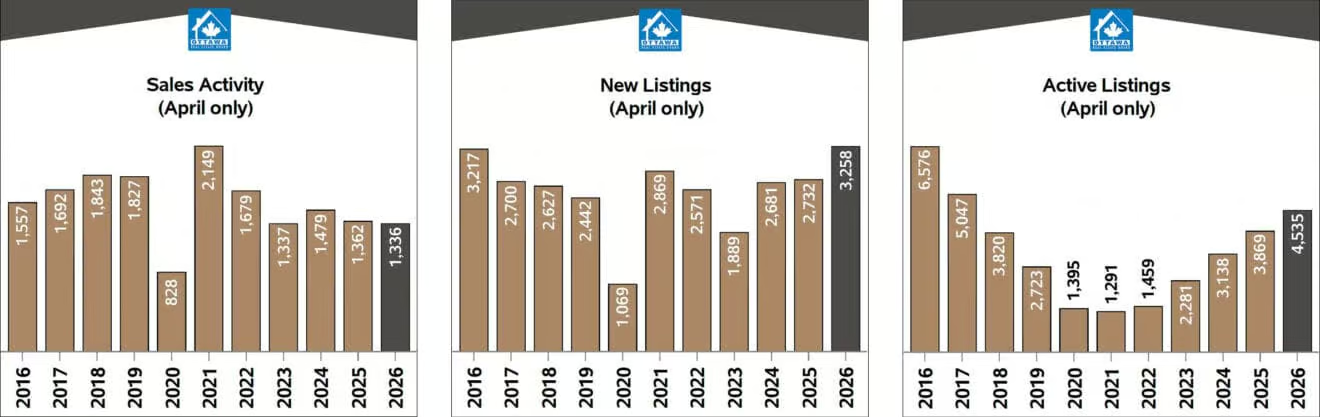
- Sales: Ottawa saw 1,336 home sales in April, up from March but still slightly below last year.
- Inventory: New listings rose to 3,258 and active listings reached 4,535, giving buyers more choice while also creating more competition for sellers. OREB describes the market as balanced, with 3.4 months of inventory and a 41% sale-to-new-listings ratio.
- Pricing: The average sale price was $712,184, up 0.8% year over year, while the median price held steady at $650,000.
- Segment Highlights:
- Single-family homes: 3.1 months of inventory in April, with an average sale price of $862,916.
- Townhomes: sat at 3.0 months of inventory with an average price of $556,172.
- Condos: Apartments were still a little stagnant at 4.9 months of inventory, with an average sale price of $425,935.
April gave us a clearer picture of where Ottawa’s real estate market is heading this spring: not overheated, not stalled — balanced, active and very local.
What This Means for Sellers
This is not a “list anything and get multiple offers” market. Buyers have more options, and they are comparing value carefully. That said, well-prepared, well-priced homes are still moving. The urgency for sellers is about getting ahead of the competition before inventory builds further through spring.
What This Means for Buyers
Buyers have more breathing room than they did in the 2021–2022 market, but waiting for a dramatic price drop may not be the best strategy. Prices have been holding in a narrow range, and OREB notes that benchmark prices are beginning to stabilize after earlier declines.
The opportunity right now is choice: more listings, less panic, and more room to make a thoughtful decision.
Mortgage and Financing Outlook
The Bank of Canada held its policy rate at 2.25% on April 29, with inflation expected to rise near-term because of higher oil prices, then ease toward 2% in early 2027. The key risk is uncertainty: U.S. trade policy, tariffs, and global energy prices could still affect inflation and fixed mortgage rates.
For clients renewing or buying, the message is: do not assume rates will fall quickly.Stability is helpful, but affordability still depends heavily on pre-approval, rate holds, debt ratios, and choosing the right mortgage structure.
Policy and Rule Changes to Know
First-time buyers purchasing new construction may now benefit from the federal First-Time Home Buyers’ GST/HST rebate, which eliminates the federal GST portion on new homes up to $1 million and provides partial relief between $1 million and $1.5 million. CRA says applications are open.
Ontario has also proposed temporary first-time buyer relief in the 2026 provincial budget, and the combined federal-provincial measures could provide meaningful upfront relief for qualifying new-home buyers.
Also in the news is a proposed $8.8-billion Canada–Ontario infrastructure program that would prioritize municipalities reducing development charges by 30% to 50% for at least three years — important because development charges on new single-detached homes can exceed $60,000.
Ottawa Jobs and the Public-Service Factor
Ottawa’s economy is still supported by a large public-sector employment base, but that stability is not the same as immunity. Ottawa’s unemployment rate was 6.2% in April, up slightly from March, while the local economy added 9,200 total jobs, including 10,700 full-time jobs.
At the federal level, the government has committed to reducing the federal public service from nearly 368,000 employees in 2023–2024 to about 330,000, with reductions already underway through attrition, expired funding and workforce adjustment.
For Ottawa homeowners, this matters because household confidence, job security, and relocation decisions all influence local real estate demand.
The Bottom Line
Ottawa is in a balanced spring market — but balanced does not mean boring. Buyers have more options. Sellers need sharper strategy. Financing is steadier, but not cheap. And policy changes may create real opportunities, especially for first-time buyers and new construction.
Let’s Talk Strategy
If you are thinking about buying, selling, renewing a mortgage, or simply figuring out what your home is worth in today’s market, this is a good time to get clear on your numbers and your options.
If you’d like a custom neighbourhood-level snapshot or insights specific to your property or goals — reach out today. I’m ready to provide you with clarity, strategy, and a steady hand through these shifting conditions.


Get Strategic Guidance
Whatever your needs—from navigating the luxury real estate market to solving commercial real estate problems—we guide you with proven strategy and objective advice.